7 Ways AI Chatbots Increase Website Conversions
AI chatbots boost website conversions with instant engagement, personalized guidance, 24/7 support, real‑time objection handling, and smarter lead qualification.
7 Ways AI Chatbots Increase Website Conversions
AI chatbots are transforming how businesses engage with website visitors, driving conversions by addressing common friction points like unanswered questions and slow response times. Here's why they work:
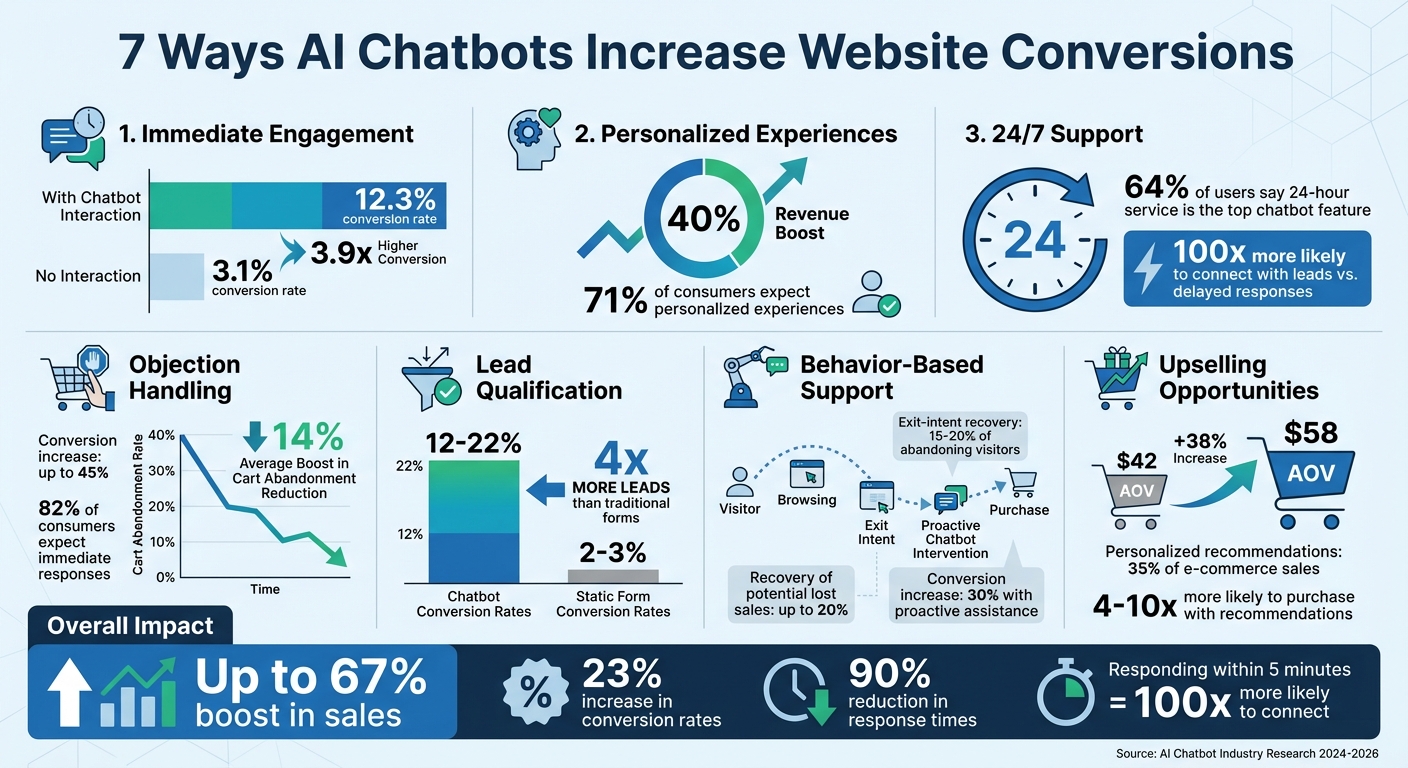
- Immediate Engagement: Chatbots respond instantly, increasing the likelihood of converting visitors - shoppers who interact with chatbots convert at 12.3%, compared to 3.1% for those who don’t.
- Personalized Experiences: They tailor interactions based on user behavior or past visits, which can boost revenue by 40%.
- 24/7 Support: Always available, ensuring no lead is missed, even outside business hours.
- Objection Handling: Resolve doubts in real time, reducing cart abandonment and increasing conversions by up to 45%.
- Lead Qualification: Chatbots gather and qualify leads conversationally, achieving conversion rates of 12–22% compared to static forms' 2–3%.
- Behavior-Based Support: Proactively assist based on user actions, recovering up to 20% of potential lost sales.
- Upselling Opportunities: Recommend products or upgrades during interactions, increasing order values and driving additional sales.
Businesses using AI chatbots have reported up to a 67% boost in sales and significantly higher lead conversion rates. These tools simplify the user experience, ensuring visitors get the answers and guidance they need to take action.
AI Chatbot Conversion Statistics: 7 Ways to Boost Website Sales
How AI Chatbots Increase Website Conversions & Sales
sbb-itb-b3fe1da
1. Personalized Guidance for Visitors
Personalized guidance plays a critical role in turning visitors into leads. Generic experiences often fall flat, while tailored interactions resonate with users. In fact, 71% of consumers expect brands to offer personalized experiences, and businesses that excel in this area see 40% higher revenue compared to their peers.
Personalization Capabilities
AI chatbots excel at using real-time data to create tailored conversations. They consider factors like the page a visitor is viewing, how they arrived at your site (e.g., Google Ads, LinkedIn, email), and their browsing behavior. Instead of a bland "How can I help you?" greeting, a chatbot might say, "Looking for pricing on our enterprise plan?" if the visitor landed on the pricing page from a Google search. This level of contextual awareness immediately makes the interaction feel relevant.
These bots also recognize returning visitors, greet them by name, and reference past interactions. For example, if someone browsed your product catalog last week but didn’t make a purchase, the chatbot can pick up where the conversation left off. This seamless continuation eliminates the need for visitors to re-explain themselves, creating a smoother, more engaging experience.
Real-Time Engagement
Unlike traditional search bars that rely on exact keywords, AI chatbots can interpret natural language queries. For instance, if someone types "running shoes for flat feet", the chatbot understands they’re looking for stability features and can recommend specific options. This consultative approach makes it easier for users to find what they need, fast.
Take LEGO’s "Ralph" chatbot as an example. During the holiday season, it guided shoppers based on criteria like age, interests, and budget, resulting in a 6x return on ad spend. Similarly, Sephora’s Messenger bots boosted conversion rates by 11% by helping users find products tailored to their needs.
Lead Generation Effectiveness
Personalized, real-time interactions also make lead capture more effective. Static forms, which often feel impersonal and tedious, typically convert at just 2–3%. Chatbots, on the other hand, gather information conversationally. Instead of asking for multiple fields of data upfront, they might say, "Can I send the pricing info to your email?" This natural flow of conversation can achieve conversion rates of 12–22%.
The key is reducing friction. By asking 3–4 targeted questions - such as those about budget, timeline, or decision-making authority - chatbots qualify leads without overwhelming them. This approach works well because it feels less like an interrogation and more like assistance. In fact, 38% of first-time buyers are more likely to make a purchase on websites with live chat, as it provides instant answers and removes uncertainty.
2. Instant Objection Handling
AI chatbots excel at tackling sales hesitations head-on, offering instant solutions to potential roadblocks. When visitors encounter doubts, they often leave if their questions go unanswered. In fact, 82% of consumers expect an immediate response to their inquiries. Unfortunately, most websites force users to sift through FAQ pages or wait hours for email replies. Chatbots solve this by addressing concerns the moment they arise.
Real-Time Engagement
Timing is everything when it comes to converting visitors. For instance, if someone lingers on a pricing page, a chatbot can step in with a proactive message like, "Have questions about our pricing? I can guide you through it". This kind of real-time intervention can increase conversion rates by over 45%. On the flip side, waiting even 24 hours can cause lead-to-appointment rates to plummet from 80% to just 25%.
Exit-intent triggers also play a key role. By offering discount codes or answering last-minute questions, chatbots can recover up to 20% of sales that might otherwise be lost. A great example is David's Bridal, which saw its AI assistant "Zoey" independently sell $30,000 worth of dresses by addressing customer concerns in real time back in early 2026.
Automation Features
Chatbots do more than just respond - they anticipate. By tracking user behavior, such as scroll depth or time spent on a page, they can detect hesitation and offer assistance before a visitor even asks. For instance, if someone questions a product's price, the bot might provide an ROI calculator to show how the product pays for itself within six months or suggest flexible payment plans. If trust is the issue, it can instantly share testimonials or return policies.
H&M's fashion chatbot is a standout example. In 2026, it engaged over 2 million customers monthly, answering product questions and offering personalized style advice. This approach made users 3 times more likely to complete a purchase. The bot handled complex concerns about sizing, fit, and style compatibility - tasks typically requiring a sales associate. By mimicking in-store guidance, it helped customers overcome "choice paralysis", asking about their preferences and suggesting tailored options.
"Potential clients are looking for answers when they reach out, not days later." – Richard Combellack, Chief Commercial Officer, nurtur.group
By addressing concerns upfront, these bots enhance the likelihood of conversion.
Lead Generation Effectiveness
Instantly resolving objections doesn’t just reduce abandonment - it actively boosts conversions. For example, a retail brand saw a 315% increase in conversions after deploying a chatbot to answer specific product-fit questions. Similarly, Domino’s reported that by January 2026, its chatbot was managing millions of orders monthly, leading to a 25% increase in customer satisfaction by simplifying the ordering process and resolving queries on the spot. Immediate answers to questions about shipping, compatibility, or warranties help customers move from "maybe" to "buy" without hesitation.
Chatbots also combat cart abandonment effectively, boosting conversion rates by an average of 14%. Quick responses to shipping questions or delivery timelines prevent users from leaving their carts behind. With 71% of customer questions resolved without human intervention and problem resolution happening 18% faster than with human agents, chatbots turn potential objections into completed transactions. These swift interactions not only resolve doubts but also create a smoother path to purchase.
3. Behavior-Based Support
AI chatbots take customer engagement a step further by analyzing user behavior in real time, offering support even before users know they need it.
These chatbots keep an eye on actions like time spent on a page, scrolling patterns, and mouse movements to spot hesitation. For example, if someone spends 90 seconds on a pricing page, the chatbot might step in with a question like, "Need help choosing the right plan?". This kind of proactive assistance can increase conversions by 30%, compared to relying on passive lead forms.
Personalization Capabilities
By studying browsing habits, chatbots build detailed profiles that help fine-tune their responses over time. This behavior-driven personalization allows chatbots to interpret user intent - whether someone is researching, comparing options, or ready to make a purchase - and adjust their messaging accordingly. Businesses that excel in this area see 40% more revenue than those that don't.
Chatbots also personalize greetings based on referral data. For instance, visitors arriving from ads might see a message about pricing, while blog readers could get content-related suggestions. By analyzing UTM parameters and URL data, chatbots can align their opening messages with user intent, boosting click-through rates by 30%.
Automation Features
Strategic triggers are key to effective chatbot automation. For instance, exit-intent detection engages users just as they’re about to leave - when their mouse moves toward the browser’s close button, the chatbot might pop up with a special offer or quick assistance. This tactic can recover 15–20% of abandoning visitors. Similarly, scroll-depth triggers activate when users reach 70% of a page, signaling strong interest and creating an ideal moment to ask for contact details.
Instead of overwhelming users with long forms, chatbots collect information one question at a time, making the process feel more like a conversation than data gathering. This approach is highly effective: conversational lead capture generates 4x more leads than traditional static forms. The chatbot can also qualify leads on the spot by asking about budget, timeline, or specific needs, and then syncs this data directly to your CRM. This ensures sales teams have full context for every interaction.
Lead Generation Effectiveness
The results speak for themselves. Websites using AI chatbots experience a 23% increase in conversion rates compared to those without them. Speed is critical too - responding to a lead within the first minute can boost conversion chances by over 45%. Companies using proactive chatbot engagement have reported a 67% increase in sales.
4. Automated Lead Qualification and Capture
AI chatbots have transformed the way businesses gather prospect details by replacing static forms with conversational interactions. Instead of asking visitors to fill out rigid forms, chatbots engage them in natural conversations to collect key information like names, emails, and phone numbers. This method has proven to be far more effective, generating 4x more leads compared to traditional website forms.
Automation Features
Using frameworks like BANT - Budget, Authority, Need, Timeline - chatbots streamline the qualification process. They ask targeted questions to quickly identify serious prospects. For example, in just 3-4 questions, a chatbot might inquire about budget range, decision-making authority, or purchase timelines. This keeps the interaction smooth while collecting the data your sales team needs.
Once a lead is qualified, the chatbot can seamlessly transfer the details and conversation history to your CRM, whether it's Salesforce, HubSpot, or another platform. High-priority leads can even trigger actions like booking meetings by presenting available time slots through integrated calendar tools. For instance, in 2024, Intercom introduced an advanced qualification bot that increased qualified leads by 73% and reduced the time sales teams spent on initial qualification by 50%.
This level of automation ensures a faster, more efficient handoff to sales, setting the stage for quicker conversions.
Real-Time Engagement
Timing is everything. Engaging a prospect within five minutes of their visit makes your business 100 times more likely to connect and convert compared to waiting an hour. AI chatbots excel at this by instantly interacting with visitors, especially on high-intent pages like pricing or demo request sections.
Take DogGoneTaxi, for example. In February 2026, they introduced an AI chatbot to automate quote requests and qualify leads. The result? A 37% increase in visitor-to-lead conversion rates. Similarly, Babylon Health used an AI chatbot to handle patient inquiries, leading to a 200% rise in qualified telemedicine leads and a 60% reduction in customer acquisition costs.
These examples highlight how chatbots not only enhance lead capture but also ensure timely, meaningful engagement with prospects.
5. 24/7 Availability
Real-Time Engagement
Being available around the clock means never missing a chance to connect with potential customers. Your website visitors don’t stick to a 9-to-5 routine. Someone might be checking out your pricing page late at night or researching your product in the early hours. And when they do, they expect immediate answers. A striking 64% of internet users say that 24-hour service is the top feature of chatbots. Quick, real-time responses - no matter the hour - hugely increase the chances of converting a lead. In fact, chatbots that operate 24/7 are up to 100 times more likely to connect with potential customers compared to delayed responses.
AI chatbots solve the "after-hours" challenge effortlessly. For instance, during the December 2024 holiday season, AutoConverse’s AI chatbot captured leads while sales teams were off-duty. The result? 32.4% of those interactions turned into potential customers. This kind of availability ensures you’re not leaving revenue on the table.
Automation Features
Of course, being available 24/7 only works if the chatbot can actually handle visitor requests. Today’s AI chatbots are equipped to do just that. They can scan your website, product pages, and help documents to deliver accurate answers without requiring human input. Plus, they use smart behavioral triggers - like detecting when a visitor is about to leave or has been idle too long - to engage them proactively before they disappear.
Take Bank of America’s virtual assistant, Erica, as an example. By 2023, Erica had managed over 1.5 billion interactions for 37 million customers, operating non-stop. This not only boosted profits by 19% but also drove a 35% year-over-year increase in customer engagement. On top of that, chatbots can handle tasks like scheduling meetings - letting qualified leads book demos directly via integrated calendar tools at any time. This kind of seamless automation enhances the user experience while also driving lead conversions.
Lead Generation Effectiveness
Offering 24/7 support keeps the momentum going when it comes to converting leads. The numbers speak for themselves: businesses using AI chatbots have seen lead conversions jump by as much as 67%, while response times have dropped by 90%. Compare that to traditional contact forms, which typically convert at only 2–3%. Chatbots, on the other hand, achieve conversion rates that are four times higher.
Amtrak’s virtual assistant, Julie, provides a great example of how this works in practice. In just one year, Julie handled over 5 million inquiries, leading to a 25% increase in bookings and a 30% rise in revenue per booking. By being available whenever visitors are ready - whether it’s during a quick lunch break or late-night browsing - chatbots ensure you’re capturing leads at the exact moment their interest is highest.
6. Smart Lead Scoring
Smart lead scoring takes automated lead capture a step further by identifying high-intent prospects in real time, helping businesses focus their efforts where it matters most.
Automation Features
Not all website visitors are created equal - some are just browsing, while others are actively searching for a solution. Smart lead scoring equips AI chatbots to differentiate between these groups by blending traditional criteria like BANT (Budget, Authority, Need, Timeline) with behavioral cues such as visits to pricing pages, time spent on key sections of your site, and urgency expressed during conversations.
Here’s how it works: as visitors interact with your chatbot, it assigns points based on their actions and responses. For instance, someone who says, "I need a solution ASAP" and frequently visits your pricing page will score higher than someone who only skims a blog. Once a lead hits a predefined score - say, 60 points - the system automatically updates your CRM and notifies your sales team via email.
Real-Time Engagement
The beauty of smart lead scoring is that it doesn’t wait for a form submission to take action. It works during the conversation, enabling immediate, tailored engagement. High-scoring leads, flagged as "Hot", can be instantly directed to a live sales rep or prompted to schedule a demo using built-in calendar tools. For example, Capital One’s chatbot, Eno, achieved a 40% increase in product recommendations and boosted new account openings by 25% through this type of real-time interaction.
Meanwhile, "Warm" leads - those planning to buy in 1–3 months - are sent into customized email nurture campaigns, while "Cold" leads are given access to self-serve resources. This tiered system ensures sales teams prioritize ready-to-buy prospects, while AI continues to nurture others.
Lead Generation Effectiveness
Automating the lead scoring process doesn’t just save time - it delivers results. Businesses see up to a 20% boost in conversion rates and a 300% improvement in lead quality. For example, Babylon Health leveraged an AI chatbot to double the number of qualified leads for telemedicine consultations and increased conversions from free symptom checks to paid consultations by 35%.
"The most expensive thing you can do in sales is spend your time with the wrong prospect." – Jeb Blount, Founder of Sales Gravy
Smart lead scoring ensures your sales team spends its time wisely, connecting with the prospects most likely to convert.
7. Product Recommendations and Upsells
AI chatbots take real-time engagement and smart lead scoring to the next level by delivering tailored product recommendations and upsell opportunities that drive conversions.
Personalization Capabilities
AI chatbots use CRM data - like past purchases, browsing habits, and preferences - to create a more personalized shopping experience. Instead of overwhelming users with a full catalog, they ask targeted questions like, "What style are you looking for?" or "What's your budget?" to gather zero-party data. This personalized approach triggers automated upsell opportunities.
Here’s a stat to consider: personalized recommendations now account for about 35% of all e-commerce sales. Customers who receive these tailored suggestions are 4 to 10 times more likely to make a purchase. A great example of this in action is Sephora's "Reservation Assistant" on Facebook Messenger. By using its "Color IQ" technology to offer personalized beauty recommendations, Sephora saw an 11% increase in appointment bookings by 2025.
Automation Features
Chatbots also excel at identifying behavioral triggers. For instance, if a customer keeps revisiting a product page, the bot might suggest a premium version or highlight the product's long-term value. If price becomes a concern, the bot can respond with payment options or explain the return on investment.
Brands are already seeing results. One e-commerce company leveraging Aidify's AI cross-sell flows increased its Average Order Value from $42 to $58 in just 60 days. Similarly, Fromages d'ici, a Canadian cheese retailer, used its chatbot, "Froméo", to help customers navigate a 1,000-item catalog. By asking about flavor and texture preferences, the bot narrowed options down to a few personalized recommendations.
"A chatbot personalizes during the conversation - learning preferences in real time and adapting suggestions as it goes." - Sarah Chudleigh, Researcher & AI Content Lead, Botpress
Real-Time Engagement
Timing is everything when it comes to upselling. Chatbots are designed to recognize hesitation - like lingering on a product page for 90 seconds - and step in to address concerns. This consultative approach simplifies decision-making by offering a curated selection of options, reducing decision fatigue. In fact, AI-powered upsell strategies have been shown to boost conversion rates by up to 23%, while personalized interactions can increase overall conversion rates by as much as 30%.
Persistent communication channels, like WhatsApp, also play a role. For example, immediately suggesting a matching accessory after a purchase taps into peak engagement moments. This matters because 71% of consumers expect a personalized experience, and 76% feel frustrated when it’s missing. Real-time engagement isn’t just a nice-to-have - it’s essential for successful upselling.
Conclusion
AI chatbots are reshaping how websites convert visitors by removing the common obstacles that often drive them away. Instead of making users deal with static forms or wait hours for a reply, chatbots step in immediately - answering questions, tackling objections, and qualifying leads on the spot. The impact is clear: businesses using AI chatbots have reported up to a 67% boost in conversion rates, with some seeing four times the number of leads compared to traditional methods.
The seven strategies discussed - ranging from personalized guidance and instant objection handling to round-the-clock availability and smart product recommendations - work together to create an effortless and engaging experience. Timing is everything: responding within five minutes makes you 100 times more likely to connect with a lead and 21 times more likely to qualify them. Achieving that level of responsiveness manually is nearly impossible.
For businesses looking to streamline lead generation, tools like LeadPilot offer a simple yet powerful solution. With a one-line embed that works on any website, this platform uses AI to learn from your content, qualify leads automatically, and send instant email alerts when high-value prospects are active. Starting at just $49/month for 1,000 conversations, it’s a cost-effective way to capture more leads without needing advanced technical know-how.
Companies already leveraging AI chatbots aren’t just making small improvements - they’re transforming how they turn visitors into customers. If you’re still using static forms and delayed responses, you could be missing out on significant growth opportunities.
FAQs
What pages should my chatbot appear on first?
Your chatbot should make its debut on pages with heavy traffic and high intent - places where visitors are most likely to interact and take action. These include the homepage, landing pages, product pages, and checkout pages. These spots are key because they attract users who are either exploring your offerings or are close to making a purchase. A chatbot here can step in to provide instant answers, assist with decisions, and help nudge them toward completing their journey.
How do I train a chatbot to answer accurately from my site?
To get your chatbot to deliver accurate responses, the key lies in teaching it to effectively understand and utilize your website’s content. Start by making your site’s data accessible - this can be done by either uploading the data or crawling it. Then, clearly define the goals for the chatbot’s responses based on what users need. Train the bot using relevant content from your website and ensure its knowledge base is updated regularly. Finally, test the chatbot frequently and refine its answers to keep them accurate and aligned with user expectations.
When should a chatbot hand off to a human agent?
When a chatbot hits its limits - whether it's struggling with a complicated issue, technical support request, or a need for personalized advice - it’s time to involve a human agent. These situations often require human judgment that a chatbot simply can’t provide.
If a user directly asks for a human or starts showing signs of frustration, transferring to an agent can help keep the experience positive. To ensure a seamless transition, the chatbot should pass along relevant context to the agent. This avoids unnecessary repetition, reduces confusion, and helps maintain the user’s trust.