Live Chat vs AI Chat Widget: Which Converts Better?
Compare live chat and AI chat widgets — conversion rates, costs, response times, and when to use AI, humans, or a hybrid to boost leads.
Live Chat vs AI Chat Widget: Which Converts Better?
When it comes to boosting website conversions, two tools dominate: live chat and AI chat widgets. Here’s the quick takeaway:
- Live chat connects visitors with human agents, offering a personal touch. It’s great for high-value, complex interactions and can increase conversions by up to 20%. However, it’s costly ($3,000–$12,000/month) and limited to business hours.
- AI chat widgets provide instant, 24/7 responses at a fraction of the cost (starting at $39/month). They convert 10–20% of visitors and handle unlimited chats, but may struggle with nuanced or emotional queries.
The best solution? Use both. AI handles routine inquiries and lead qualification, while live agents focus on closing complex or high-value deals.
Quick Comparison
| Feature | Live Chat | AI Chat Widget |
|---|---|---|
| Conversion Rate | 8–15% | 10–20% (up to 40%) |
| Response Time | 30 seconds – 2 minutes | Under 5 seconds |
| Availability | Business hours only | 24/7/365 |
| Monthly Cost | $3,000–$12,000 | $39+ |
| Scalability | Limited by agent capacity | Unlimited simultaneous chats |
Both tools have strengths. Choose based on your business needs - or combine them for the best results.
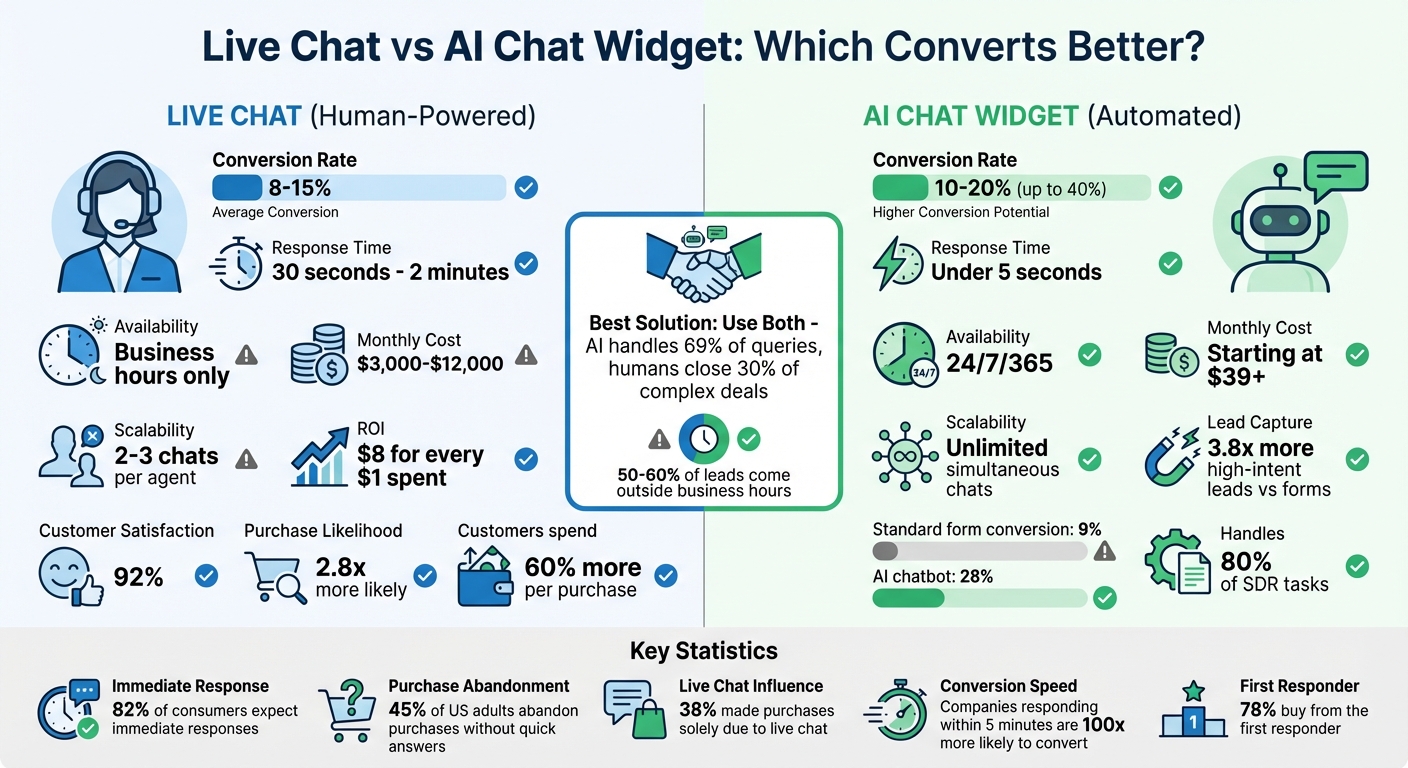
Live Chat vs AI Chat Widget: Feature Comparison and Conversion Metrics
Chatbot or AI Agent? The Best Choice for Ecommerce in 2026
sbb-itb-b3fe1da
How Live Chat Affects Conversions
Live chat connects website visitors with real agents in real time, creating a direct path to higher conversions. When a visitor interacts with a live chat agent, they are 2.8 times more likely to make a purchase. Why? Because humans bring empathy, persuasion, and trust-building to the table - qualities that automated systems often lack. A skilled agent can read between the lines, address emotional concerns, and adapt responses to match a visitor's specific needs.
The numbers back this up. Businesses using live chat often see a 20% boost in overall conversion rates. Customers who engage via chat also tend to spend 60% more per purchase. Even more compelling, 38% of customers say they’ve made a purchase solely because of a live chat interaction. And for every dollar spent on live chat, businesses can see an ROI of up to $8.
"Live chat is the ultimate sales hack... It's the easiest way to bump your website conversions in real-time without split testing."
- Neil Patel, Co-Founder, NP Digital
The success stories are hard to ignore: Virgin Airlines experienced a 23% increase in conversions, Intuit reported a 190% conversion jump and a 211% boost in sales, and an e-commerce company achieved a 3.84% lift in conversion rates alongside a 6% revenue increase.
Benefits of Live Chat
The strongest advantage of live chat? It delivers an instant, human connection. When visitors have questions about pricing, shipping, or product details, a live agent can respond immediately. This reduces friction, prevents cart abandonment, and keeps potential customers engaged while their interest is still high. In fact, 45% of US adults admit they’ll abandon an online purchase if they can’t get a quick answer. By responding in under 60 seconds, live chat helps resolve concerns before visitors lose interest.
Live chat also excels at dynamic lead qualification. Agents can ask follow-up questions, gauge intent, and direct high-value leads to sales teams. This personalized interaction makes visitors feel like individuals rather than just another ticket number. Agents can reference past conversations and adjust their tone to fit the situation - something automated systems often struggle to do. It’s no surprise that live chat has a consumer satisfaction rate of 92%, the highest of any customer support channel. One study even found that exchanging just six messages through live chat can increase the likelihood of an e-commerce conversion by nearly 250%.
Drawbacks of Live Chat
Despite its advantages, live chat does have its challenges. Availability is a big one. Many businesses only staff live chat during standard hours (9:00 AM to 6:00 PM), but 50–60% of leads often come in outside these hours. This can frustrate visitors who see a chat widget but receive no response. Even during operating hours, 21% of live chat conversations go unanswered due to agent overload, which can damage customer trust.
Another obstacle is cost. Staffing live chat requires significant resources. A typical 9-hour coverage day needs 1.5–2 full-time agents, costing anywhere from $3,000 to $12,000 per month when you factor in software, fees, and training. On top of that, resolving each support ticket handled by a human agent costs $5 to $10 on average.
Scalability is also a concern. A single agent can only handle 2 to 3 conversations at a time. During traffic spikes, this limitation can lead to longer wait times and poorer response quality, causing potential customers to give up and leave. For businesses experiencing rapid growth or seasonal surges, maintaining consistent chat coverage can become a logistical headache. While live chat offers powerful benefits, AI chat widgets present an alternative that addresses some of these challenges.
How AI Chat Widgets Affect Conversions
AI chat widgets work around the clock, stepping in the moment someone visits your site. They use triggers like exit intent, time spent on a page, or how far someone scrolls to start conversations before visitors leave. This proactive approach helps capture up to 3.8 times more high-intent leads compared to static forms.
The numbers speak for themselves. Standard web forms convert about 9% of visitors into leads, while AI chatbots achieve a much higher conversion rate of around 28%. Speed plays a big role here - 82% of consumers expect brands to respond immediately when contacted. AI chat widgets deliver responses within seconds, which is critical. Companies that engage with leads within five minutes are 100 times more likely to connect and convert them, and 78% of customers tend to buy from the company that responds first. This quick reaction not only improves conversion rates but also lays the groundwork for smarter, automated customer interactions.
"A qualified chatbot qualifies leads - not just answers questions."
AI chat widgets don’t just respond fast - they work smart. They use the BANT framework (Budget, Authority, Need, Timeline) to evaluate leads in real time before a human agent steps in. Some systems even use a dual-agent setup to manage conversations while analyzing engagement, cutting lead qualification time by 62%. These tools can handle up to 80% of tasks typically assigned to Sales Development Representatives, leading to three times higher sales conversions compared to traditional web forms.
Benefits of AI Chat Widgets
AI chat widgets bring scalability that human agents simply can't match. While a live agent can juggle two or three conversations at most, AI chat tools manage unlimited chats simultaneously. This ensures no visitor is left waiting, even during ad campaign traffic spikes or seasonal rushes.
Cost is another major advantage. Unlike live chat, which requires ongoing expenses like salaries, training, and shift coverage, AI chat widgets run on fixed monthly fees. These often start as low as $39 to $99 per month, making them an accessible option for small businesses and startups looking to capture leads without hiring a full support team.
AI widgets also shine in proactive engagement. They use prompts like "Want a custom quote in 60 seconds?" to align with what visitors are looking for. Advanced systems, such as LeadPilot, incorporate Retrieval-Augmented Generation (RAG) and fact-validation layers to ensure responses are accurate, reducing errors by over 70%. You can train these tools using your own product documents, FAQs, and pricing sheets, ensuring every interaction reflects your brand. Plus, they integrate directly with CRMs, triggering instant follow-ups for promising leads.
Drawbacks of AI Chat Widgets
Despite their strengths, AI chat widgets aren’t perfect. They can falter in complex or emotionally charged situations that require human empathy and judgment. For instance, inquiries about custom pricing, contract negotiations, or complaints might result in technically correct but impersonal responses. These scenarios often benefit from a human touch.
Another challenge is avoiding robotic interactions. If the AI isn’t well-trained on your specific content, conversations can feel stiff, causing visitors to lose interest. Even with advanced fact-checking, the AI might occasionally miss context or fail to fully address a visitor’s unique needs. For high-value sales or intricate B2B deals, AI widgets are most effective as a first step - capturing and qualifying leads before passing them to a human closer.
Live Chat vs. AI Chat Widgets: Side-by-Side Comparison
Choosing between live chat and AI chat widgets often comes down to weighing their unique strengths. Live chat offers a personal, empathetic touch, while AI chat widgets excel at speed and handling high volumes. Let’s dive into the numbers to see how they measure up.
Live chat typically converts 8–15% of engaged visitors, while AI chat widgets boast a slightly higher conversion rate of 10–20%, with top-performing setups reaching an impressive 30–40% range. When it comes to response time, live chat agents usually take 30 seconds to 2 minutes to reply, whereas AI widgets respond almost instantly - within 5 seconds. Considering that 82% of consumers expect an immediate answer, those seconds can make a big difference.
Cost and scalability also highlight key differences. Running live chat 24/7 can cost anywhere from $3,000 to $12,000 per month. Meanwhile, AI chat widgets start at just $39 per month, with pricing unaffected by the number of chats handled. While a live agent can juggle only 2–3 chats at once, AI tools can handle thousands of conversations simultaneously without breaking a sweat.
"The truth is, the debate isn't about chatbot vs. live chat - it's about chatbot + live chat. Businesses that combine both often see the best results."
- Ruben Buijs, Founder, Boei
Comparison Table: Live Chat vs. AI Chat Widgets
| Feature | Live Chat | AI Chat Widget |
|---|---|---|
| Conversion Rate | 8–15% | 10–20% (up to 40% with qualification) |
| Response Time | 30 seconds – 2 minutes | Under 5 seconds |
| Availability | Business hours only | 24/7/365 |
| Monthly Cost | $3,000–$12,000 (staffing + software) | $39+ (subscription) |
| Scalability | Limited by agent count | Unlimited simultaneous chats |
| Lead Qualification | Manual and flexible | Automated and structured |
Up next, we’ll help you determine which solution aligns best with your business goals.
Which Option Is Right for Your Business?
Fine-tuning your chat strategy can significantly boost conversion rates by aligning customer needs with the right engagement tools. Live chat is ideal for personalized, high-value interactions, while AI widgets offer scalable, round-the-clock lead capture.
When Live Chat Works Best
Live chat shines in scenarios where trust and human connection are essential. For example, it’s the go-to choice for industries like legal services, medical consulting, or enterprise-level B2B sales - especially for deals exceeding $5,000. Here, live agents excel at managing detailed, emotionally sensitive conversations that require a human touch.
It’s also a smart fit for websites with moderate traffic. In these cases, dedicating an agent to address inquiries can create personal connections that drive conversions more effectively.
When AI Chat Widgets Work Best
AI chat widgets are a cost-effective solution for capturing leads 24/7. They eliminate the staffing costs associated with live chat, making them especially appealing to small businesses. With AI, you can handle unlimited simultaneous conversations without adding headcount.
For high-traffic websites, such as those in e-commerce, SaaS, or local home services (like HVAC or plumbing), AI widgets deliver strong ROI. Research shows they can boost qualified leads by up to 3.8× compared to static forms. Plus, businesses that respond to inquiries within five minutes are 21× more likely to qualify a lead.
Using Both: The Hybrid Approach
While each solution has its strengths, combining them can unlock even greater potential. AI can act as the first point of contact, handling approximately 69% of straightforward customer queries. Using frameworks like BANT (Budget, Authority, Need, Timeline), it can pre-qualify leads before seamlessly passing complex or high-value interactions to human agents.
"The businesses winning at lead generation aren't choosing one over the other - they're combining both." - SparkAgentAI
A hybrid model ensures round-the-clock lead capture through AI while escalating about 30% of more nuanced inquiries to live agents. This approach not only maximizes efficiency but also caters to the 86% of customers who prefer having the option to speak with a human agent.
Conclusion
Pick the tool that aligns best with your business goals. Live chat brings a personal touch, making it ideal for closing complex, high-value deals. On the other hand, AI chat widgets shine with their ability to provide instant, round-the-clock responses and manage an unlimited number of conversations simultaneously.
Speed matters - a response within five minutes can significantly boost lead conversion rates. AI tools excel at handling about 69% of straightforward queries without needing human intervention.
When used thoughtfully, both options offer unique benefits. For example, LeadPilot is a cost-effective way to scale lead generation without increasing staff. Starting at $49 per month, its AI-powered widget works 24/7 to capture and qualify leads, seamlessly integrates with your website, and sends instant email alerts for high-intent prospects. The Starter plan supports up to 1,000 conversations per month, while the $199 plan offers unlimited conversations - saving you a considerable amount compared to hiring even one support agent.
The smartest strategy combines both tools. Let AI handle the bulk of inquiries and qualify leads around the clock, while human agents focus on the 30% of conversations that are complex or high-value, ensuring those deals close successfully.
Whether you go with AI, live chat, or a mix of both, acting quickly is crucial. Don’t let potential leads slip through the cracks - timely responses can make all the difference.
FAQs
How do I know if AI or live chat will convert better for my site?
AI chat widgets can significantly enhance engagement by interacting with visitors immediately. They can capture up to 3.8 times more high-intent leads and improve conversion rates by as much as 40% when they respond promptly. On the other hand, live chat shines when dealing with more complex questions, offering a personal touch that leads to satisfaction rates of approximately 85%.
The choice depends on your goals: AI chat is ideal for speed and handling large volumes, while live chat is better suited for delivering tailored support. For the best of both worlds, consider combining the two approaches.
When should an AI chat hand off to a human agent?
When an AI chat encounters a situation that's too complex, unproductive, or falls beyond its confidence level, it should transition the conversation to a human agent. Indicators such as sentiment analysis, task difficulty, or repeated inquiries can signal the need for this handoff. This ensures the customer experience remains seamless and effective, even when AI reaches its limits.
What should I track to prove chat is increasing revenue?
To demonstrate how chat can drive revenue, focus on tracking essential metrics such as the chat-to-conversion rate, the number of qualified leads captured, average response time, and the ROI generated from chat interactions. For instance, live chat has been shown to increase conversions by 10–20%, with even higher results in certain industries. By consistently monitoring these KPIs, you can clearly see the impact chat has on boosting revenue.